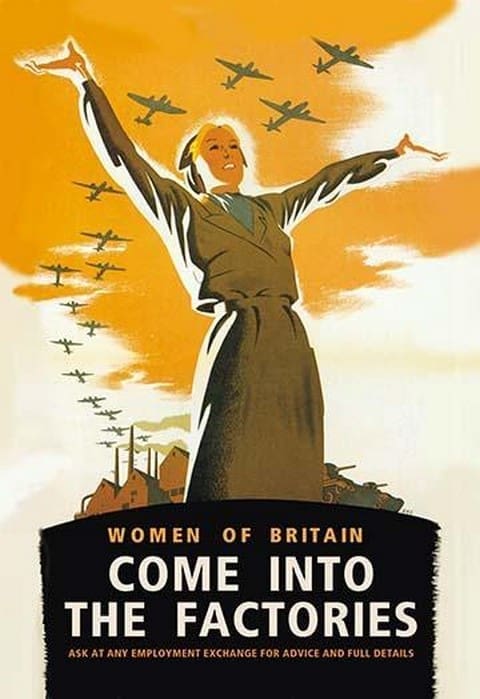
The poster “Women of Britain, Come into the Factories” was created by artist Philip Zec during World War II as part of a British government campaign to encourage women to join the wartime industrial workforce. This striking piece of propaganda features a confident and capable woman in work overalls and a headscarf, standing in front of a backdrop of a bustling factory. The visual composition emphasizes strength, purpose, and national unity, aiming to reshape traditional gender roles and portray factory work as both patriotic and essential. Zec’s choice of vivid colors and bold lines captures attention immediately, while the direct gaze of the central figure conveys a sense of pride and determination. At a time when large numbers of men were serving in the military, women were urgently needed to fill roles in munitions plants and other war-related industries. Posters like this were not only recruitment tools but also cultural statements, reframing domestic identities into heroic contributors to the war effort. Philip Zec was one of the most influential visual communicators of Britain’s war years. As a political cartoonist for the “Daily Mirror,” he used his art to inspire morale, highlight injustice, and critique complacency, often walking a fine line with wartime censors. His 1942 poster “Don’t Waste Bread” caused controversy for its grim depiction of a torpedoed merchant seaman, yet Churchill himself defended it. Zec’s posters and cartoons were known for their emotional power and clarity, qualities that made them highly effective in rallying public support and engagement. He worked closely with the Ministry of Information, producing artwork that spanned themes of labor, sacrifice, and national duty. Today, his contributions to wartime visual culture are widely recognized, and “Women of Britain, Come into the Factories” remains one of his most enduring and iconic works.