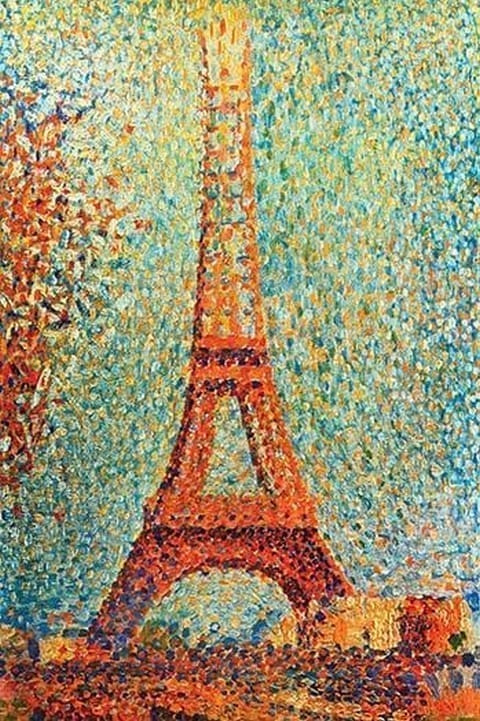
“The Eiffel Tower” by Georges Seurat is a remarkable example of the artist’s mastery of Pointillism, a technique he pioneered in the late 19th century. Painted in 1889, the same year the Eiffel Tower was completed, the work captures the monument rising into a hazy Parisian sky, its form delicately rendered through Seurat’s meticulous application of tiny dots of pure color. The painting’s luminous, atmospheric quality reflects his deep understanding of optical mixing, a method also evident in his celebrated masterpieces “A Sunday Afternoon on the Island of La Grande Jatte” and “Bathers at Asnières”. In “The Eiffel Tower,” Seurat departs from the grand, crowded compositions of his larger works, instead presenting a more solitary, poetic vision of the newly constructed landmark. The interplay of warm and cool tones creates a subtle vibrancy, while the tower itself appears almost weightless, dissolving into the sky. Seurat’s ability to transform a rigid iron structure into a shimmering spectacle of light and color demonstrates his unique approach to modern urban landscapes. Though unfinished, “The Eiffel Tower” remains a testament to Seurat’s groundbreaking exploration of color theory and his commitment to capturing the essence of contemporary life through scientific precision and artistic intuition.