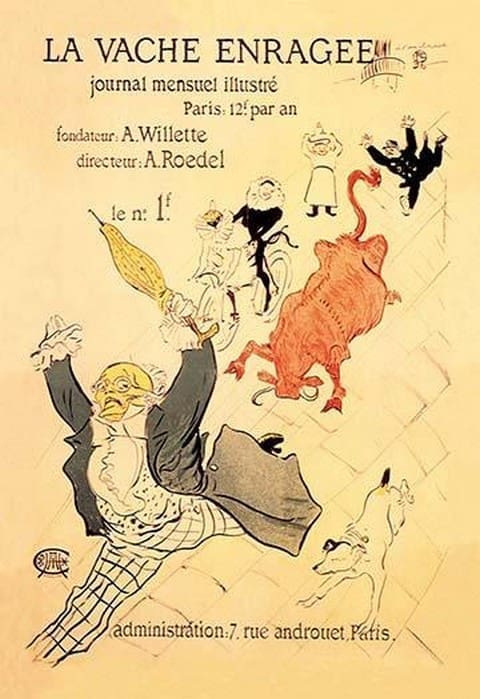
In this poster there are clear references to Adolphe Willette’s humorous themes and rococo style of illustration style of illustration. Willette was the founder and illustrator of the short-lived monthly ‘La Vache Enragee’ (the angry cow) edited by the cartoonist Adolphe Roedel. This coloured poster of the same title was commissioned for the appearance of the magazine March 1896. As a reference to the wretched financial state of most artists, the term ‘manger de la vache enragee’ (meaning roughly, ‘meaning not having enough to eat’) was adopted as the motto for the ‘Vachalcade’ which was held on Montmartre annually from 1896. This was an artists’ procession, with fanfares and allegories on fame and the muses; it also included a furious cow and a troupe of pretty girls as a satire on Europa with the bull. The event was organized by Roedel. Henri de Toulouse-Lautrec, a defining figure of the Post-Impressionist movement, is best known for his evocative depictions of Parisian nightlife, particularly in Montmartre, where he immersed himself in the world of cabarets, dance halls, and bohemian culture, capturing its energy and decadence with a distinctive, dynamic style influenced by Japanese prints, Impressionism, and Art Nouveau; in works such as “Ambassadeurs: Aristide Bruant dans Son Cabaret,” he used bold, flat areas of color and strong outlines to create striking promotional posters that elevated advertising to an art form, while “Babylone d’Allemagne (German Babylon)” showcased his ability to blend caricature with social commentary, illustrating the hedonistic atmosphere of the era; his work frequently celebrated the performers and working-class figures who inhabited the entertainment world, as seen in “Les Chansonniers de Montmartre,” which highlights the intimate, theatrical nature of Montmartre’s music scene, while “La Vache Enragee (Roughing It)” reflects his empathy for struggling artists, an experience he understood well due to his own physical disability and aristocratic background, which set him apart yet granted him unique access to both high society and the underbelly of Parisian life; though his contemporaries included van Gogh, Gauguin, and Degas, he developed a signature aesthetic rooted in movement, expressive line work, and psychological depth, positioning him as a key transitional figure between Impressionism and modern graphic design, influencing both 20th-century poster art and avant-garde movements that followed, as his groundbreaking approach to composition and advertising blurred the line between fine art and commercial illustration.
Reviews
There are no reviews yet.