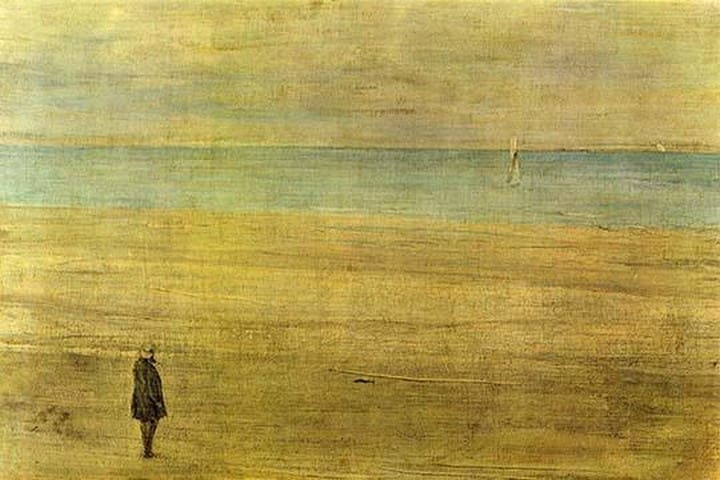
James Abbott McNeill Whistler’s “Harmony in Blue and Silver – Trouville” (1865) exemplifies the artist’s transition toward his signature aesthetic philosophy of “art for art’s sake.” This small, evocative painting captures the quiet elegance of a seaside view in Trouville, France. The composition is simple yet sophisticated: a muted palette of soft blues and silvers conveys the tranquility of the scene, while the thin, horizontal brushstrokes mimic the shimmering effect of light on water. Whistler’s focus is not on precise details but on the mood and atmosphere, inviting the viewer to feel the serenity of the coastline. This work showcases Whistler’s ability to reduce landscapes to their essential forms and colors, a precursor to his later tonal compositions.
Whistler (1834–1903) was an American-born, London-based artist whose career spanned several movements, including Realism, Impressionism, and Aestheticism. Initially trained in Paris under Charles Gleyre, he adopted elements of the French avant-garde but forged a distinctive style that prioritized mood over narrative. His most famous work, “Arrangement in Grey and Black No.1” (1871), commonly known as “Whistler’s Mother,” cemented his reputation. Throughout his career, Whistler advocated for the visual and emotional impact of art, emphasizing harmony in color and form over storytelling, leaving an enduring legacy in modern art.