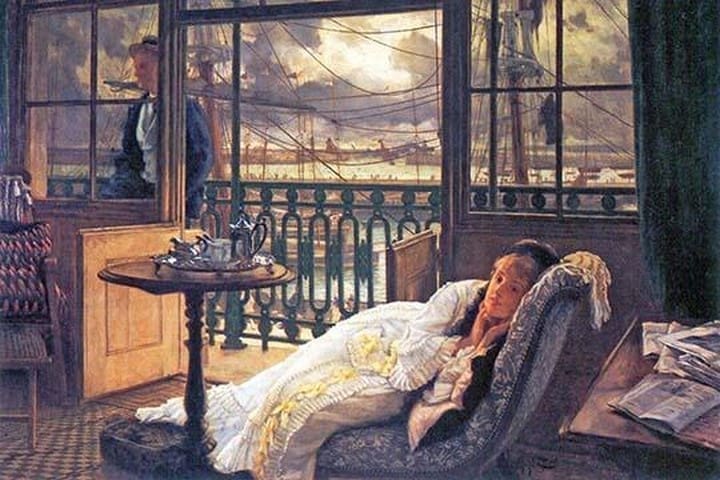
“A Storm Moves Over” is a captivating painting by the French artist James Tissot, completed in the late 19th century. This masterpiece depicts a dramatic scene of a storm approaching, with dark clouds gathering overhead and waves crashing against a rocky shore. Tissot’s skillful use of light and shadow creates a sense of impending doom and turmoil, as the tumultuous weather threatens to unleash its fury.The painting’s composition is dynamic, with the diagonal lines of the crashing waves and the windswept trees adding to the sense of movement and chaos. Despite the impending storm, there is a haunting beauty in the scene, with Tissot capturing the power and majesty of nature in all its glory.”A Storm Moves Over” is celebrated for its evocative portrayal of the forces of nature and the raw power of the elements, showcasing Tissot’s talent for capturing the drama and intensity of the natural world. James Tissot, a French painter and illustrator, is renowned for his detailed and vibrant depictions of modern life in the Victorian era. Born in 1836, Tissot initially trained in Paris, where he developed a style blending academic precision with the atmospheric qualities of Impressionism. His work often focused on themes of fashion, society, and femininity, showcasing his fascination with the elegance and complexities of contemporary women. Tissot’s move to London in 1871 marked a significant phase in his career, where he gained popularity for his portraits of high society and meticulously composed domestic scenes, blending realism with romantic sentimentality. A profound turning point occurred following the death of his muse and companion, Kathleen Newton, leading Tissot to embark on an exploration of spiritual themes and biblical subjects. His later works, particularly a series illustrating the life of Christ, are noted for their historical accuracy and narrative depth, influenced by his travels to the Middle East. Tissot’s ability to blend technical mastery with a keen eye for storytelling and human emotion has ensured his enduring legacy, making his works a bridge between the artistic traditions of 19th-century realism and the emerging narrative art of modernity.