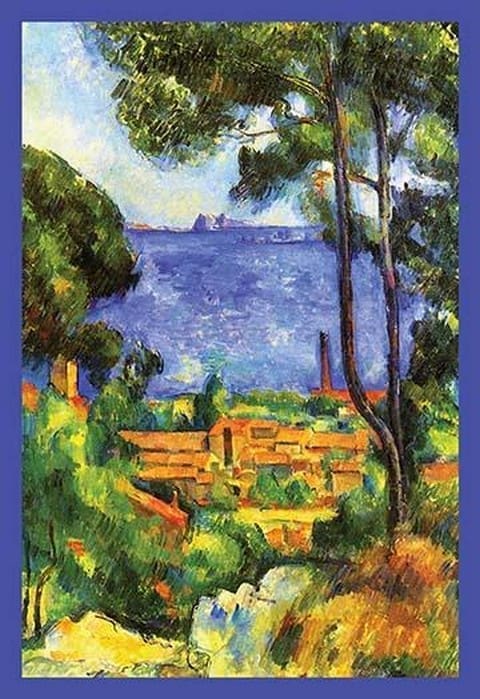
Paul Cezanne’s paintings are celebrated for their revolutionary approach to composition, color, and form, earning him the title “father of modernism” and securing his place as a pivotal figure in art history. His landscape “Fruit Garden in Pontoise” highlights his ability to blend natural elements with structured geometry, creating a vivid sense of place. In “House in Provence” and “Le Chateau de Medan,” Cezanne’s fascination with architecture and the interplay of light and shadow reflects his unique perspective on solidity and depth. His portraits, such as “Gustav Boyer in Straw Hat,” convey the psychological presence of his subjects through subtle, layered brushwork and muted, harmonious tones. The theatricality of “Harlequin” explores Cezanne’s interest in capturing character and movement, standing out as one of his more playful and symbolic works. Meanwhile, “Into the Street” exemplifies his ability to depict everyday scenes with monumental simplicity, reducing complex forms to their essential shapes and colors. Throughout his career, Cezanne’s mastery of spatial distortion and his revolutionary treatment of form, color, and perspective profoundly influenced movements like Cubism and Fauvism. His work continues to inspire artists and art lovers alike, securing his legacy as a cornerstone of modern art.