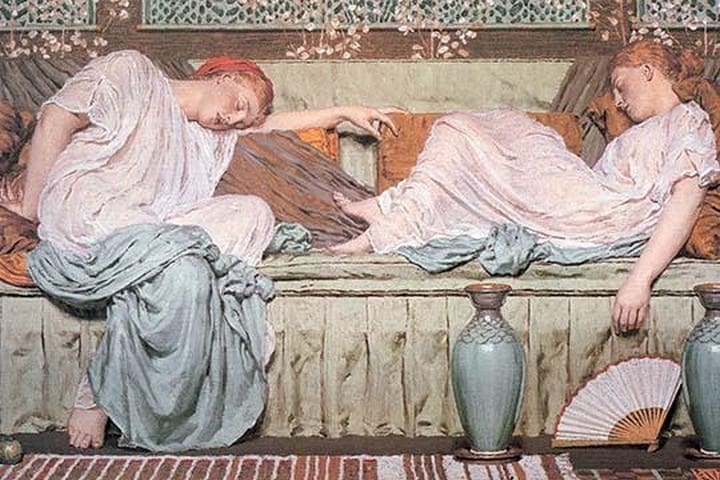
Albert Joseph Moore (1841-1893) was an English painter celebrated for his captivating depictions of languorous female figures set against the backdrop of classical luxury and decadence1. Born in York, England, Moore hailed from a family of artists, including his well-known portrait-painter father, William Moore. His early works exhibited the influence of John Ruskin, but it was in the mid-1860s that Moore’s art took a distinctive turn. Inspired by the Elgin Marbles at the British Museum, he delved into classical subjects, creating elaborately draped female figures-often diaphanously veiled-imbued with a sense of timeless beauty. Moore’s paintings, characterized by formalized proportions, exquisite color harmonies, and floral accessories, became emblematic of the Aesthetic Movement. His oeuvre includes works like “A Garden” (1869) and “Elijah’s Sacrifice” (1863), the latter reflecting influences from artists such as Ford Madox Brown and Edward Armitage. Beyond canvas, Moore also designed tiles, wallpaper, and stained glass, leaving an indelible mark on the Victorian artistic landscape.