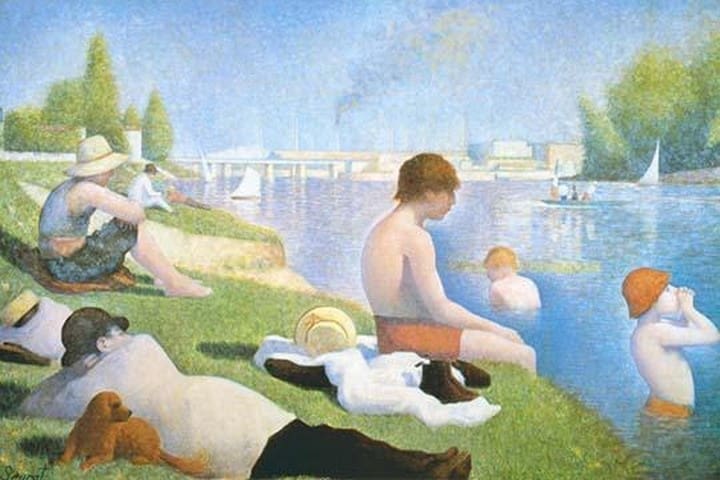
“Bathers at Asnières” is one of Georges Seurat’s most important early works, showcasing his transition from traditional Impressionism to the more structured and scientific approach that would define his career. Painted in 1884, the large canvas depicts a tranquil riverside scene where young men and boys relax along the banks of the Seine in the industrial suburb of Asnières, their figures bathed in warm sunlight. Unlike the fleeting brushstrokes of the Impressionists, Seurat employs a precise, disciplined technique, using small, controlled dabs of color to create a luminous effect. The painting’s serene composition and careful use of light foreshadow his development of Pointillism, which he perfected in later works like “A Sunday Afternoon on the Island of La Grande Jatte” and “The Eiffel Tower”. The juxtaposition of leisure and industry, with factory smokestacks in the background, reflects Seurat’s interest in modern life and the social contrasts of the time. Though initially rejected by the official Salon, the painting is now considered a masterpiece of early Neo-Impressionism, demonstrating Seurat’s ability to merge classical composition with groundbreaking color theory. “Bathers at Asnières” remains a striking testament to his innovative vision and his dedication to transforming the way light and form are represented in painting.