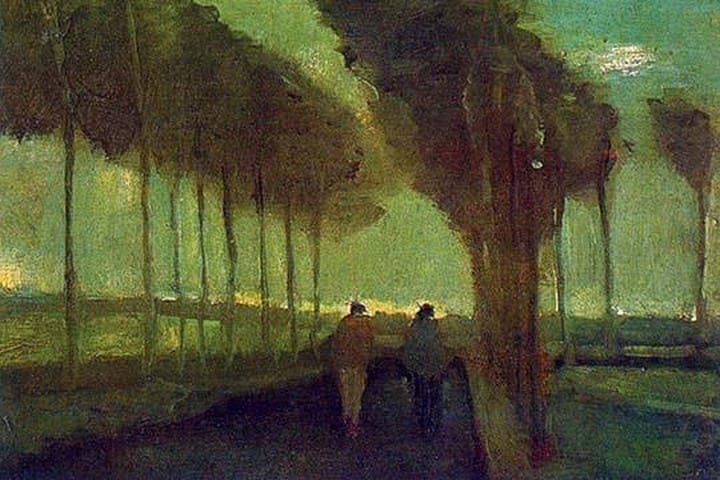
Vincent van Gogh’s “Avenue with Two Figures,” painted in 1884, is a poignant exploration of human connection set against the tranquil backdrop of a tree-lined path. This work, created during his time in Nuenen, captures the serene beauty of the Dutch countryside while simultaneously delving into the themes of companionship and solitude. The composition is dominated by the avenue itself, with towering trees stretching upwards, their canopies almost touching to form a natural archway that draws the viewer’s eye towards the distant horizon. The two figures, diminutive in scale, walk side by side along the path, their presence emphasizing both the vastness of the landscape and the intimacy of their companionship. Van Gogh’s use of a muted color palette, with soft greens and browns, evokes a sense of calm and introspection. His characteristic brushwork, textured and expressive, imbues the scene with a tangible quality, making the viewer feel as if they could step into the painting and join the figures on their walk. The careful attention to light and shadow, with dappled sunlight filtering through the leaves, adds depth and a sense of realism to the scene. “Avenue with Two Figures” is not merely a landscape painting; it is a meditation on the human experience, capturing the quiet moments of connection that define our relationships. Through this work, van Gogh invites us to reflect on the simple yet profound act of walking together, finding solace and companionship in the shared journey along life’s paths.