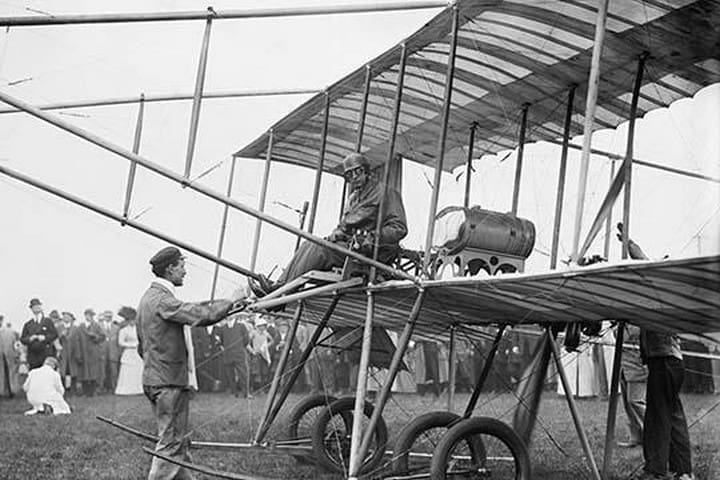
Clifford B. Harmon was an influential American aviation pioneer, adventurer, and early 20th-century entrepreneur whose passion for flight and exploration greatly contributed to the popularity and development of aviation in its formative years. Born in 1866, Harmon initially pursued a successful career in real estate, but his interest in the skies eventually led him to become one of the earliest private aviators in the United States. Harmon’s love for flying grew quickly, and by 1910, he was making headlines with his record-breaking flights in balloons and airplanes. He was one of the founding members of the Aero Club of America, an organization dedicated to advancing aviation through competition and public enthusiasm. In 1910, Harmon won the Gordon Bennett Cup, a prestigious international balloon race, and set multiple records, including for altitude and endurance. His achievements extended beyond ballooning, as he also participated in numerous airplane competitions, helping to establish aviation as a viable mode of transport and sport. Recognizing the importance of acknowledging achievements in aviation, Harmon later established the Harmon Trophy, awarded annually to the world’s best aviators for their accomplishments in various aspects of flight, including speed, endurance, and innovation. The trophy aimed to celebrate and inspire aviators who displayed remarkable courage, skill, and advancement of aviation technology, and it eventually became one of the highest honors in the field. Harmon’s contributions went beyond competition; he was a strong advocate for the potential of aviation to connect people across vast distances and enhance international cooperation. He envisioned a future where airplanes would enable rapid travel, opening new possibilities for commerce, exploration, and even world peace. During World War I, Harmon’s commitment to aviation led him to serve as a U.S. Army aviator, further solidifying his dedication to the cause of advancing flight. His fascination with aviation wasn’t limited to personal achievements; he was dedicated to promoting aviation’s benefits to society at large. After the war, he continued to support the aviation industry through both personal sponsorships and his leadership roles in various aviation organizations. As a forward-thinking enthusiast, Harmon constantly pushed for further advancements in aviation technology and infrastructure, advocating for improved airplane designs, better flight training, and the establishment of airports and airways. His efforts not only inspired a new generation of aviators but also helped to lay the foundation for modern aviation practices. Throughout his life, Harmon remained a passionate supporter of flight and an advocate for its transformative power. His legacy lives on through the Harmon Trophy and the countless advancements in aviation that his enthusiasm and support helped to make possible, marking him as a visionary whose contributions shaped the trajectory of 20th-century aviation. Harmon passed away in 1945, but his impact endures as a testament to his belief in the power of flight to bridge distances and foster a sense of global unity.