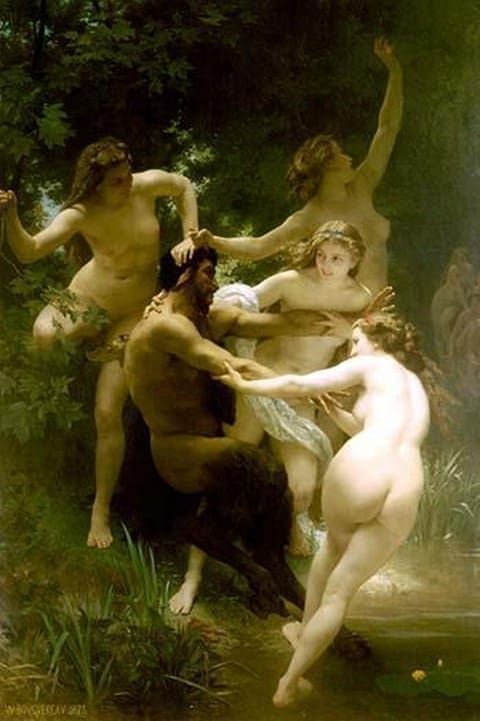
Nymphs and satyrs are creatures from Greek mythology. Nymphs are considered to be minor female deities, and have a duty to protect different elements of nature such as streams, mountains and meadows. The male counterpart of the nymph is the satyr. A satyr is a figure from Greek mythology having the torso and face of a man, ears and tail of a horse, and feet of a goat. They are legendary for being lustful and fertile.
Bouguereau captures an incredible sense of motion in this piece. The four nymphs tease and play with a satyr by trying to pull him into a lake. One nymph waves to three other nymphs behind her in the distance, perhaps beckoning them to also come and play with the satyr. Entranced by their beauty, the satyr half-heartedly tries to resist the nymph’s wiles. One can feel the struggle of the satyr to keep his ground, and the joyous struggle of the nymphs to pull him in.
William Bouguereau exhibited the painting “Nymphs and Satyr,” accompanied by a verse from the Latin poem that inspired it, at the 1873 Paris Salon. From 1888, the piece was displayed for 13 years in the bar of the Hoffman House in New York City.
“Nymphs and Satyr” is one of many Bouguereau paintings on classical themes, such as “The Birth of Venus,” “Psyche,” “The Lost Pleiad,” and “Homer and his Guide.”
William-Adolphe Bouguereau (1825-1905) was a prominent French academic painter known for his realistic genre paintings and mastery of the human form. Bouguereau’s work is characterized by its meticulous attention to detail, smooth brushwork, and idealized depictions of the human body, particularly female nudes. His subjects often included mythological themes, rural and domestic scenes, and religious motifs, all executed with a high degree of technical precision and beauty. He was adept at rendering textures, such as skin and fabrics, and his compositions often conveyed a serene and harmonious atmosphere. During his career Bouguereau enjoyed significant acclaim and success. He exhibited regularly at the Paris Salon, where he received numerous awards and honors. His paintings were sought after by collectors and patrons, and he was regarded as a leading figure in the academic art world of the 19th century. Despite his popularity during his lifetime, Bouguereau’s work fell out of favor with the rise of modernist movements in the early 20th century, which critiqued his adherence to traditional techniques and themes. In recent decades, there has been a resurgence of interest in Bouguereau’s work, with contemporary audiences and critics recognizing his technical skill and contributions to art.1873/Sterling & Francine Clark Institute, Williamstown, MA