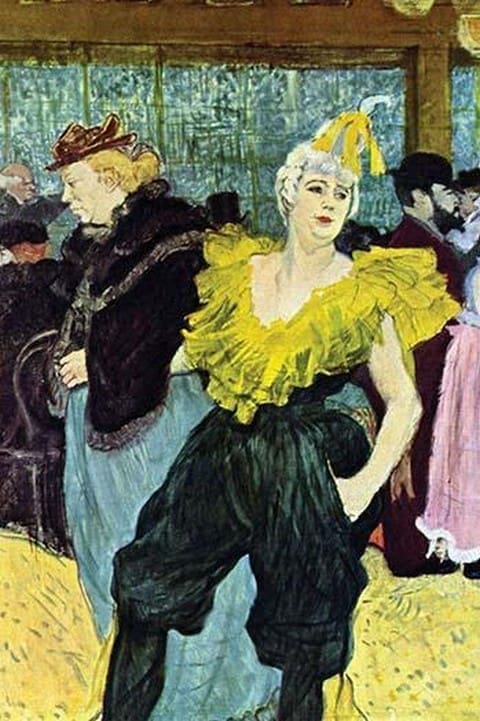
The Toulouse-Lautrec painting “The Clown Cha-U-Kao” depicts a female clown named Cha-U-Kao who performed in the Nouveau Cirque in Paris. The painting shows her dressed in a brightly colored costume, with a white ruffled collar and black top hat, sitting on a stool with a cigarette in her hand. Cha-U-Kao was a popular performer at the time, known for her androgynous appearance and her comedic routines that often involved dancing and acrobatics. Toulouse-Lautrec was fascinated by the world of the circus and frequently depicted its performers in his work. “The Clown Cha-U-Kao” is considered one of his most striking portraits of a circus performer. Henri de Toulouse-Lautrec (1864-1901) was a French artist whose vivid and evocative works captured the essence of Belle Époque Paris. His immersion in the city’s colorful and theatrical life allowed him to produce a remarkable collection of paintings, prints, and illustrations. Toulouse-Lautrec chronicled the personalities and facets of Parisian nightlife with great psychological insight. His use of free-flowing expressive lines resulted in highly rhythmical compositions, exemplified by works like “In the Circus Fernando: The Ringmaster” (1888). However, it is his lithographic posters that stand out as some of his most powerful creations. These posters, characterized by extreme simplification in outline and movement, feature large color areas and convey the energy and allure of cabarets, dance halls, and theaters. Notable works include “At the Salon,” “Elles,” and the iconic “Moulin Rouge-La Goulue.” Despite his short life, Toulouse-Lautrec left an indelible mark on the art world, capturing the spirit of bohemian Paris in his distinctive style.