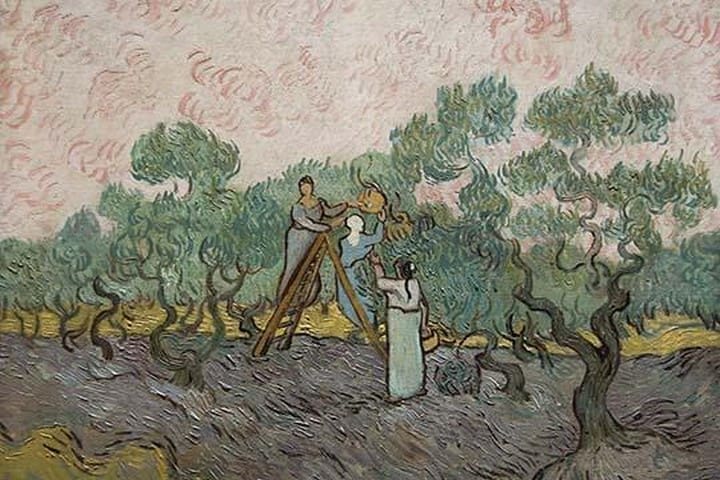
Vincent van Gogh’s “Women Picking Olives,” painted in 1889 during his time in Saint-Rémy-de-Provence, is a luminous depiction of rural life in the south of France. Set against a backdrop of rolling hills and azure skies, the painting portrays two women engaged in the timeless task of harvesting olives. Van Gogh’s bold, expressive brushstrokes and vibrant color palette capture the warmth and vitality of the scene, infusing it with a sense of energy and movement. The women, depicted with characteristic simplicity and dignity, are rendered with a keen attention to detail, from the folds of their clothing to the baskets brimming with freshly picked olives. The composition is balanced and harmonious, with the figures positioned diagonally across the canvas, drawing the viewer’s eye into the heart of the scene. Van Gogh’s use of light and shadow adds depth and dimension to the painting, with sunlight filtering through the foliage and dappling the ground with patches of golden warmth. Through “Women Picking Olives,” van Gogh not only celebrates the beauty of the Provençal landscape but also pays homage to the labor and resilience of the women who work the land. This work is a testament to van Gogh’s ability to find beauty and meaning in the ordinary, transforming a simple moment of everyday life into a timeless expression of human connection and the enduring power of nature.