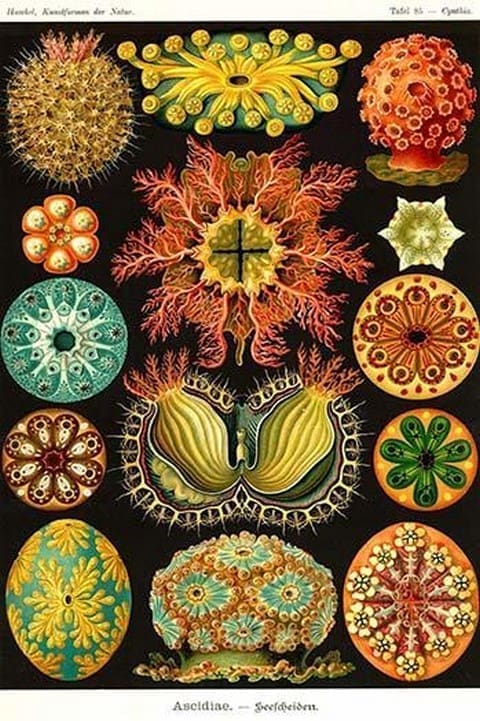
Ernst Haeckel, a German biologist, naturalist, and artist, is renowned for his extraordinary contributions to both science and art. Born in 1834, Haeckel’s work seamlessly merged these two disciplines, creating a legacy that continues to inspire. His most famous work, “Kunstformen der Natur (Art Forms in Nature),” published in 1904, is a stunning collection of detailed illustrations that depict the intricate beauty of various organisms, from radiolarians to jellyfish. Haeckel’s illustrations are characterized by their meticulous detail and vibrant colors, capturing the complexity and elegance of the natural world. His artistic talent was not merely for aesthetic purposes; it served a scientific function by providing accurate visual representations of organisms that were often too small to be seen with the naked eye. Haeckel’s work played a crucial role in popularizing the study of biology and natural history, making the microscopic world accessible and fascinating to the general public. His illustrations also reflected his deep appreciation for the interconnectedness of all living things, a concept that was influenced by his support of Darwin’s theory of evolution. Haeckel’s ability to convey scientific information through art helped bridge the gap between science and the public, fostering a greater understanding and appreciation of the natural world. Despite some of his controversial views, Haeckel’s artistic and scientific contributions remain invaluable. His work not only advanced the field of biology but also left an indelible mark on the art world, demonstrating the profound beauty of nature through the lens of scientific inquiry.
Reviews
There are no reviews yet.