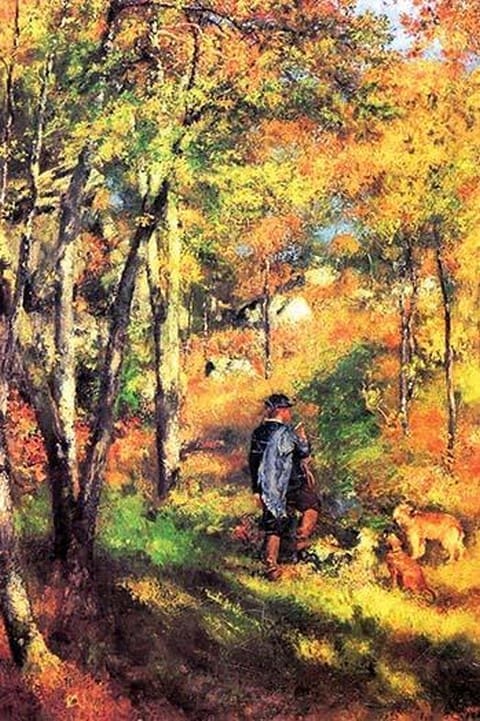
Pierre-Auguste Renoir, a defining figure of Impressionism, was celebrated for his luminous color palette, fluid brushstrokes, and ability to capture the joy and beauty of everyday life, often focusing on social gatherings, intimate portraits, and idyllic landscapes, as seen in “Le Moulin de la Galette,” where he depicted Parisians enjoying an open-air dance with dappled sunlight filtering through the trees, creating a vibrant sense of movement and atmosphere; unlike the more detached observations of Monet or the rigorous compositions of Degas, Renoir’s approach was warm and human-centered, emphasizing the sensuality of light on flesh, a quality evident in “Bather with a Terrier,” where he rendered the female figure with soft, caressing strokes that celebrated the tactile beauty of skin; his gift for portraiture, seen in “Claude Monet Reading A Newspaper,” not only documented his close friendship with fellow Impressionists but also demonstrated his ability to convey personality through expressive brushwork and a delicate handling of color and light; later in his career, Renoir moved toward a more classical style, evident in “Girls at the Piano,” where he combined Impressionist colorism with a structured composition reminiscent of the Old Masters, yet throughout his evolution, he remained devoted to capturing life’s pleasures, whether in the form of bustling city scenes, quiet domestic moments, or sunlit landscapes, leaving a legacy that blended Impressionist spontaneity with a reverence for tradition, influencing generations of artists who sought to merge expressive brushwork with the enduring beauty of the human figure.
Reviews
There are no reviews yet.