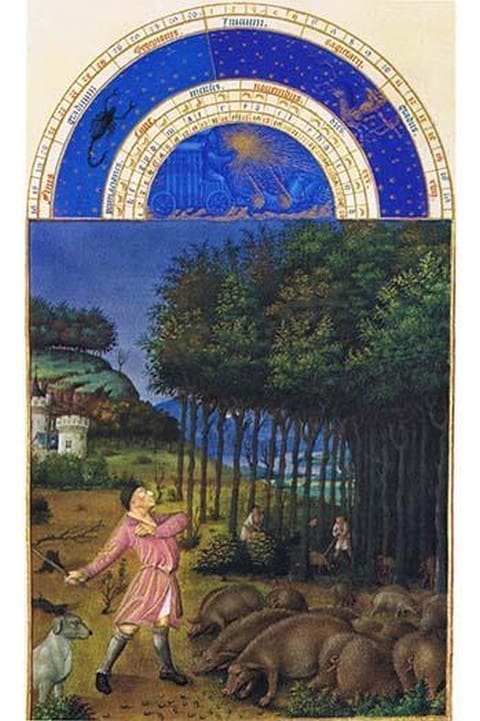
This is the only calendar image executed by Colombe; the Limbourg s painted only the zodiacal tympanum above it. The picture shows the autumn acorn harvest, with a peasant knocking down throwing sticks to knock down the acorns on which his pigs are feeding. A page from the “Labors of the Months,” the section of “Le Tres Riches Heures” illustrating the various activities undertaken by the Duke’s court and his peasants according to the month of the year. Most of the illustrations show one of the Duke’s castles in the background, and each are accompanied by a sun carrying Phoebus beneath an archway depicting the appropriate zodiac signs. “Les Très Riches Heures du Duc de Berry” is one of the most celebrated and lavishly decorated manuscripts of the medieval period, commissioned by John, Duke of Berry, a prominent French noble and art patron, around 1412. Created primarily by the Limbourg brothers—Herman, Paul, and Jean—the manuscript is a stunning example of illuminated art, showcasing the delicate skill and precision of early 15th-century miniaturists. The book serves as a devotional text, including a calendar, prayers, and Biblical readings, but it is best known for its richly detailed calendar pages that depict the labors of each month. These scenes uniquely blend religious iconography with depictions of contemporary aristocratic and peasant life, offering insights into medieval society and the Duke’s own opulent lifestyle. Each page is meticulously decorated with vibrant colors, gold leaf, and fine detailing, illustrating pastoral scenes, castle life, and celestial influences. Notably, the manuscript reflects the Limbourg brothers’ mastery of spatial perspective and naturalism, qualities rare in early medieval art, making each page appear almost lifelike. After the Limbourg brothers and the Duke passed away in 1416, additional artists, including Jean Colombe, completed the work in the late 15th century. Today, “Les Très Riches Heures” is regarded not only as a masterpiece of the International Gothic style but also as a valuable historical document that encapsulates the art, culture, and daily life of medieval France, preserved today in the Musée Condé in Chantilly, France.
Reviews
There are no reviews yet.